
How to make an espresso macchiato at home
The traditional Italian macchiato is a shot of espresso marked with a dollop of milk foam. Here's the recipe, the technique, and what to avoid.
What you'll need
- A demitasse (2 to 3 oz cup) : A standard espresso cup. Anything bigger makes the drink look sparse and cools the shot too fast.
- Fresh espresso beans : Medium or medium-dark roasts work best; the foam dollop isn't enough milk to tame a sharp light roast.
- A small amount of whole milk : You only need an ounce or two per drink. Whole milk foams denser and holds its shape longer than skim or plant milks.
- A teaspoon : For spooning the foam. A small latte-art pitcher helps if you want to pour instead.
TL;DR
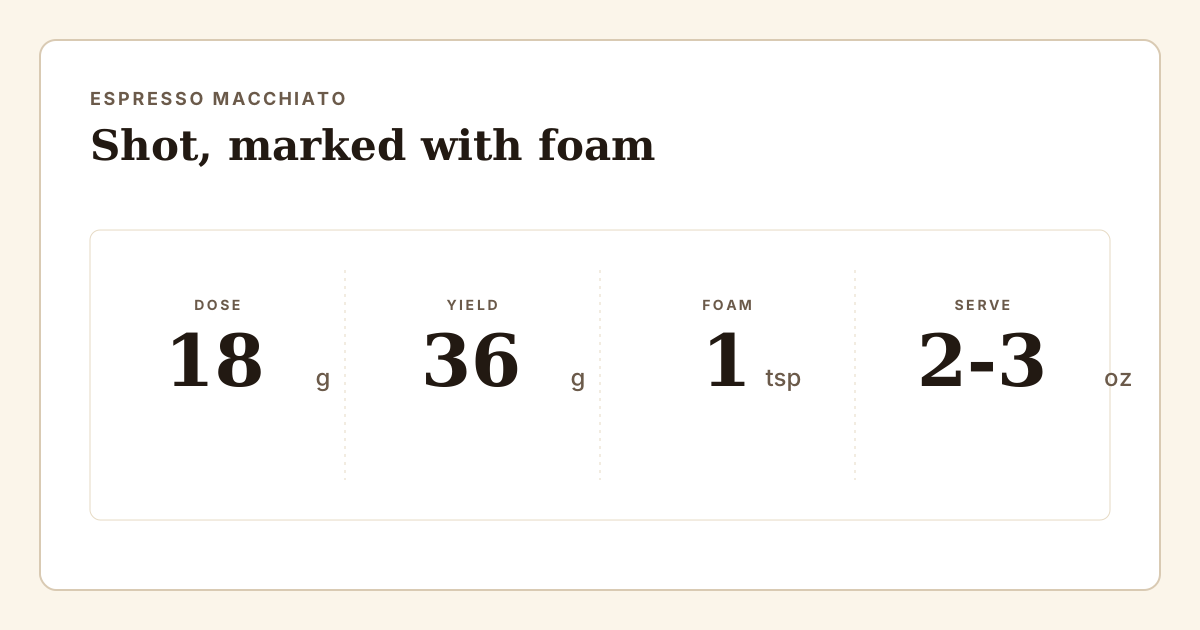
A traditional espresso macchiato is a shot of espresso with a small spoonful of milk foam on top. Pull a normal double (18 g in, 36 g out, 25 to 30 seconds), steam a small pitcher of whole milk to cappuccino texture, and spoon a dollop of foam onto the center of the shot. Total drink: 2 to 3 oz. It should taste like espresso with the sharp edges softened, not like a milk drink. If you wanted a milk drink, you wanted a cortado or a cappuccino.
What a macchiato actually is
“Macchiato” means “marked” or “stained” in Italian. The drink is espresso marked with milk, and the mark is small on purpose. A real espresso macchiato is 2 to 3 oz total: the shot plus roughly a teaspoon of foam, maybe a splash of warm milk under the foam if you’re being generous. You drink it in three or four sips.
This is the opposite of the Starbucks “macchiato,” which is a latte macchiato: a tall glass of steamed milk with espresso poured through it, often flavored with vanilla or caramel syrup. Those are 6 to 8 oz milk-forward drinks that share a name with the espresso macchiato and almost nothing else. If you order “un macchiato” at a bar in Rome, you’ll get the small one.
Compared to its cousins:
- Espresso macchiato: double shot + about a tablespoon of foam (a teaspoon on a single). 2 to 3 oz. Espresso-forward.
- Cortado: double shot + an equal amount of steamed milk. About 4 oz. Balanced.
- Cappuccino: double shot + steamed milk + thick foam. 5 to 6 oz. Milk-forward with structure.
- Latte: double shot + 5 to 6 oz of milk + thin foam. About 8 oz. Milk drink.
A macchiato is the smallest and most espresso-forward of the milk drinks. Pick the bean accordingly.
The recipe
1. Pull the shot
Standard double: 18 g in, 36 g out, 25 to 30 seconds, directly into a warm 2 to 3 oz demitasse. If you need to dial in a new bag first, work through how to dial in espresso. A macchiato is unforgiving of a bad shot because there’s barely any milk to hide behind: a sour shot stays sour, a bitter shot stays bitter. Fix the espresso before you fix the milk.
Bean choice matters more here than for a latte. A medium or medium-dark roast with chocolate or caramel notes works well; the small amount of foam softens the espresso without changing its character. Light roasts can work but tend to taste sharper in a macchiato than in bigger milk drinks. See espresso roast levels if you’re picking a bag specifically for this drink.
2. Steam the milk
Steam a normal pitcher of milk the way you would for a cappuccino. Do not try to steam one ounce; a steam wand needs 4 to 6 oz of liquid to engage properly, and anything less either scorches or stays flat. The full technique is in how to steam milk for latte art, but the short version for a macchiato:
- Fill a 12 oz pitcher one-third full with cold whole milk (around 4 oz).
- Purge the wand, submerge the tip just below the surface.
- Introduce air for 3 to 5 seconds (the hissing sound), then submerge deeper to create a whirlpool.
- Stop steaming at around 140°F, the same target as any milk drink. Past 160°F the milk tastes cooked and the foam turns dry.
- You want slightly stiffer foam than for latte art. Think glossy whipped cream, not wet paint.
Swirl and tap the pitcher to break any large bubbles, but don’t overwork it. You want the top layer to stay voluminous.
3. Mark the shot
Two acceptable methods:
The spoon method (traditional). Scoop a heaping teaspoon of foam off the top of the pitcher and drop it gently onto the center of the espresso. The foam should float as a visible white dome on the crema. This is what you’ll see in Italian bars.
The pour method (modern). Pour a small amount of milk into the center of the shot from a low height, letting the foam come through at the end. You’ll get a small white dot or heart. This is prettier but gives you more milk in the drink; it’s closer to a piccolo than a classical macchiato.
Either way, serve immediately. The foam collapses within a minute or two, so a macchiato is not a drink to make and walk away from.
The variations worth knowing
Doppio macchiato (double macchiato). Same drink, double shot. 36 g of espresso, slightly larger foam dollop (closer to a tablespoon). This is what you’ll actually make at home if you’re pulling doubles.
Macchiato caldo vs. freddo. “Caldo” is hot (the default), “freddo” is cold: a shot over ice with a splash of cold milk or cold foam. Different drink, same marking principle.
Latte macchiato. The one Starbucks popularized. Fill a tall glass with steamed milk, then slowly pour a shot through it so the espresso layers in the middle. Not the drink most of this guide is about, but legitimate if that’s what you want.
Cafe noisette (French variant). Essentially the same drink as an espresso macchiato, with a splash of warm milk instead of foam. Smoother, less visual drama.
Common mistakes
Using a latte-sized cup. A macchiato in a 6 oz cappuccino cup looks sad and loses heat within 30 seconds. Use a 2 to 3 oz demitasse. If you don’t own one, use the smallest cup in your cabinet.
Over-steaming the milk. Thick, dry foam that sits on top like a meringue is wrong. You want glossy, dense microfoam that drops onto the shot and holds a slight dome. If you can see individual bubbles, you’ve aerated too long.
Adding too much milk. A macchiato is not a mini-latte. If the foam dollop sinks the crema and turns the drink beige, you’ve used too much. The crema should still be visible around the white mark.
Pulling a bad shot and hoping the foam fixes it. It won’t. There’s not enough milk to balance an under-extracted sour shot or an over-extracted bitter one. If your shot tastes both sour and bitter at once, that’s channeling, a puck-prep problem, not a recipe problem.
Making the drink in advance. The foam collapses in about 90 seconds. Pull the shot while the milk is steaming, mark it immediately, drink it immediately.
Troubleshooting
My foam sinks into the shot and disappears. Milk was under-steamed (not enough air, too thin) or you poured warm milk instead of spooning foam. Steam a bit longer during the aeration phase, let the foam settle in the pitcher for 10 seconds, and spoon from the top layer where the densest foam collects.
My foam sits on top but tastes like nothing. Likely over-steamed. If the milk went past 160°F it loses sweetness and the foam gets dry and papery. Stop steaming earlier. You can also check the wand itself: a clogged tip aerates unevenly. Clean your steam wand if you haven’t recently.
The shot is cold by the time I’m done steaming. Pre-warm the cup (run hot water into it while the shot grinds), pull the shot first, then steam. On a single boiler you’ll need to flush and switch modes, which takes practice. If you want to pull and steam simultaneously you need a heat exchanger or dual boiler machine.
My barista oat milk won’t foam. Check the carton date and shake it hard before pouring. Opened plant milks separate and lose foaming ability after about a week. Also make sure you’re using the barista version; standard oat milk formulations don’t have the added protein and oil that let them foam.
It tastes like straight espresso and I wanted more milk. You wanted a different drink. Try a cortado (equal milk and espresso) or a flat white (more milk, less foam). The macchiato is supposed to taste like espresso.
Frequently asked
What's the difference between an espresso macchiato and a latte macchiato?
They're nearly opposite drinks that share a name. An espresso macchiato (the traditional one) is espresso 'marked' with a small spoonful of milk foam; it's a 2 to 3 oz drink that tastes like espresso with a soft edge. A latte macchiato is a tall glass of steamed milk 'marked' with a shot of espresso poured through it; it's a 6 to 8 oz milk drink. Starbucks popularized the latte macchiato (and their 'Caramel Macchiato' is a flavored version of that), which is why most Americans picture the wrong drink when they order one in Italy.
Single or double shot?
In Italy it's traditionally a single. At home, most people pull doubles because single baskets are harder to dial in and most prosumer machines ship with a double basket. A double-shot macchiato is sometimes called a 'doppio macchiato' and is perfectly legitimate. Match the foam dollop to the shot size: a teaspoon for a single, closer to a tablespoon for a double.
Can I use plant milk?
Yes, but pick a barista-formulated oat or soy. Regular plant milks don't foam into stable microfoam and the dollop will collapse into the shot within seconds. Barista-edition oat milks generally hold a dollop best; almond tends to collapse fastest, so skip it for this drink.
Do I steam just a tiny bit of milk, or steam normally and use a spoonful?
Steam normally. Trying to steam one ounce of milk in a pitcher doesn't work; the wand can't engage with that little liquid and you'll either scorch it or get no foam. Steam a normal 4 to 6 oz pitcher as you would for a cappuccino, use a spoonful on top of the shot, and drink the rest or save it for a second drink.
Hot or cold foam?
Hot. A traditional espresso macchiato uses freshly-steamed microfoam. The 'cold foam macchiato' is a modern cafe variant and a different drink. If you want the traditional version, steam the milk.
Why does mine taste like straight espresso with no milk flavor?
That's correct. A macchiato is supposed to taste like espresso with the sharp edges rounded off, not like a milk drink. If you want milk flavor, you want a cortado or a piccolo, which are also small but have more milk.