
Stuck portafilter: how to remove it without damage
A step-by-step method for freeing a jammed portafilter without gouging the gasket seat, bending the handle, or damaging the lugs.
What you'll need
- A thick kitchen towel or silicone mitt : The group head and portafilter are hot. Bare hands give you one sharp pull before you let go.
- A new group gasket (correct size for your machine) : A portafilter that sticks usually means the gasket has hardened or compressed. Have one on hand so the swap happens the same day.
- A group head brush : For cleaning the gasket seat and shower screen once you're in.
- Food-safe silicone grease (optional) : A dab on the new gasket's outer edge prevents the next seizure. Petroleum-based grease will swell rubber; don't substitute.
TL;DR
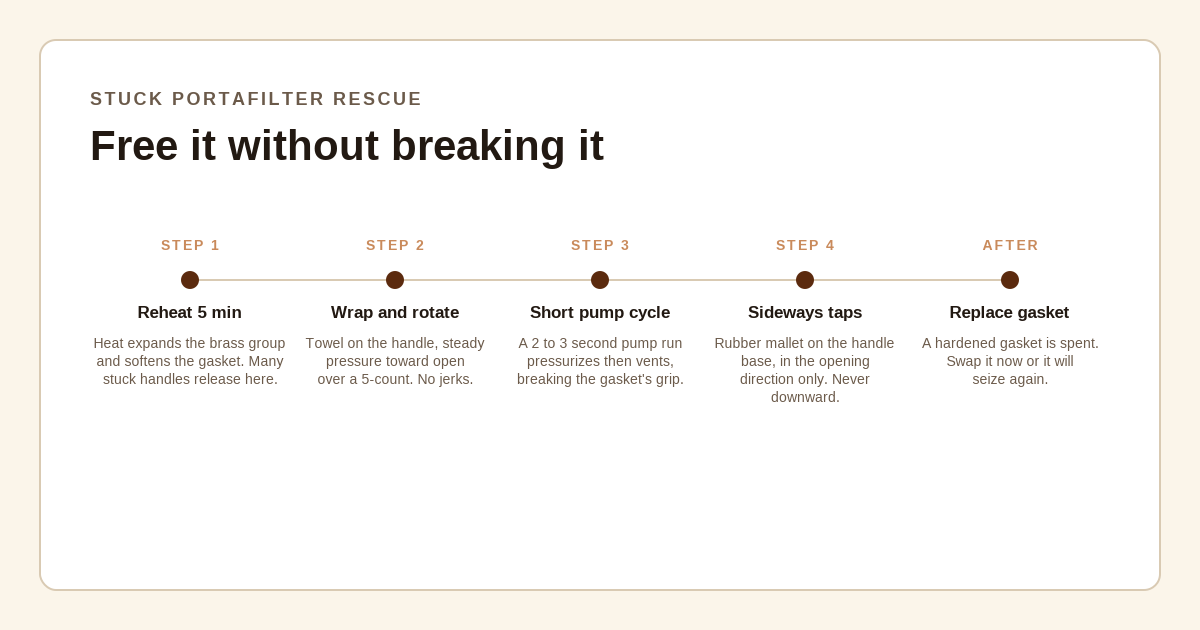
A stuck portafilter is almost always a gasket problem, not a strength problem. Reheat the group for 5 minutes, wrap the handle in a thick towel, and rotate with steady pressure (not a yank) toward the open position. If that fails, run the pump for 2 to 3 seconds to break the seal, wait for it to vent, then try again. Never hammer downward on the handle or pry with a screwdriver against the group face. Once it’s out, check the gasket and replace it if it has gone hard. A portafilter that stuck on a hardened gasket will stick again if you leave it in.
Why portafilters seize in the first place
Three things cause a stuck portafilter, and you can usually tell which one you have by how it’s stuck.
A hardened group gasket. The rubber gasket in the group head is a consumable. Under daily heat cycles it gets brittle, loses its spring, and starts to grip the basket rim it seals against. When this is the cause, the handle feels completely locked, as if welded, and may release suddenly with a pop when it finally gives. A standard rubber gasket lasts about 12 months of daily use; silicone lasts 18 to 24. If yours has never been changed, that’s your answer. The full procedure is in how to replace an espresso machine group gasket.
A machine that cooled with the portafilter locked in. If you locked the portafilter in after the last shot and left it overnight, the group contracted around it as it cooled and the gasket stiffened against the basket rim. This is the easiest kind to free: bring the machine back to temperature and it usually comes off normally.
Coffee grounds packed around the ears. Loose grounds migrate up around the basket rim and into the gap between the portafilter and the group. Over weeks they turn into a gritty paste that wedges the ears in their channels. The tell: you feel movement but it grinds and resists through the whole rotation. This one needs heat, patience, and a proper clean afterwards, not more force.
Once in a while it’s something stranger (an aftermarket gasket that is too thick, a portafilter forced in past its usual stop), but most stuck portafilters are one of the three above.
The removal sequence
Work through these in order. Stop as soon as the handle moves freely.
1. Heat it back up
Turn the machine on if it’s cold. Let it come fully up to temperature and then sit for another 3 to 5 minutes. Heat expands the brass group slightly and softens the gasket rubber. Many stuck portafilters come free at this step with no further intervention. If yours seized because the machine cooled overnight with it locked in, this is usually all you need.
2. Protect your hands
Wrap the handle in a folded kitchen towel or put on a silicone oven mitt. A bare-handed yank on a hot handle guarantees you’ll let go partway through the motion, which is exactly when the gasket breaks free and the portafilter comes out sideways with hot coffee sludge on top. The towel also gives you more grip.
3. Rotate with steady pressure
Grip the handle close to where it meets the portafilter body (not out at the end: that’s a lever that bends the stud). Push in the direction of “open,” which on nearly every espresso machine means swinging the handle to your left as you face the machine, the reverse of locking in. Apply steady, increasing pressure, not a jerk. Count to five while you push. If it’s going to release at this step, it releases somewhere in those five seconds with a soft thunk.
If you reach the point where you’re straining and the whole machine is sliding on the counter, stop. That is the force limit; past it, something bends.
4. Short pump cycle
If steady pressure didn’t work, put a cup under the spouts and run the pump for 2 to 3 seconds with the stuck portafilter still in place, then stop it. On a machine with a three-way valve, pressure builds above the puck and then vents, the same cycle a backflush uses (see how to backflush an espresso machine), and that movement can break the gasket’s grip on the basket rim.
Wait 30 seconds after the valve vents so nothing is under pressure. Try the rotation again.
5. Gentle sideways taps
Last resort before calling it. With the machine still hot, use a rubber mallet (or the heel of your palm, if you’re brave) to tap the handle sideways in the opening direction. Short taps near the base of the handle, never on the spouts or the portafilter body. Three or four taps. If nothing moves, stop there: contact the manufacturer or a service tech before you snap something.
Do not, at any point, pry with a screwdriver between the portafilter and the group face. You’ll gouge the gasket seat, which is the one surface that absolutely has to stay smooth for the new gasket to seal.
After it comes out
The portafilter is out. You’re not done. If a hardened gasket let it seize, it is still in there and will do it again.
Inspect the gasket. If it looks shiny-hard, cracked, or has a deep ring impression from the basket rim, replace it. If it still feels springy and the seize was a one-time overnight lock-in, you can leave it, but order a spare anyway. Clean the gasket seat and the shower screen while you have access; a group brush and a damp cloth are enough. The full cleaning cadence is in the espresso machine cleaning schedule.
A thin smear of food-safe silicone grease on the outer edge of the new gasket (the edge that touches the group housing, not the face that touches the portafilter) makes the next gasket change easier and stays out of the cup. Skip petroleum jelly; it swells rubber and shortens gasket life.
Common mistakes
Pulling up or down on the handle. The portafilter rotates in a horizontal plane. Any vertical force just loads the handle stud and the group mount bolts. If you’ve ever seen a photo of a bent portafilter handle, that’s how it got that way.
Prying against the group face. A screwdriver between the portafilter and group might feel like leverage but it’s gouging the gasket seat. Once you’ve put a nick in that surface, every future gasket will leak at that spot and you’ll be chasing drips forever.
Hammering downward. Downward force on the handle transfers through the portafilter ears into the ramps they ride on inside the group. Brass is tough but not indestructible, and damage there is a group-head repair rather than a gasket swap.
Leaving a hardened gasket in “to see if it happens again.” It will. You’ve already done the diagnostic. Replace it while you’re there.
Forcing a cold machine. Cold rubber is stiffer than hot rubber and cold brass is fractionally tighter. Always heat first.
Troubleshooting
The handle moved an inch and then locked. The gasket released but grounds in the ear channels are binding. Rotate back toward lock slightly to unload it, then try the open direction again with slightly more pressure. Usually frees in one or two cycles.
I hear a hiss when I try to rotate it. That’s pressure still in the basket escaping past the gasket. Stop, lock it back, and wait a full 30 seconds after the last shot before trying again. If pucks are also coming out soupy, the three-way valve may not be venting properly; the fix for that is in the cleaning schedule.
It came out but hot coffee sprayed everywhere. You pulled while the group was still under brew pressure. Next time, wait 10 to 15 seconds after the pump stops for the three-way valve to vent. If your machine has no three-way valve (some entry-level machines and many levers), pressure only bleeds off through the puck, so give it a minute or two before unlocking.
The portafilter is out but the basket stayed behind in the group. The gasket is gripping the basket rim. Cool the machine fully. Use the edge of a butter knife to work around the basket rim, easing it downward in small movements around the circumference. Don’t lever from a single point: you’ll bend the basket or mark the gasket seat. The puck will crumble out as you go.
It happens every few days now. The gasket is at end of life regardless of how it looks. A gasket that’s borderline will seize randomly depending on how long the machine sat, ambient temperature, and how hard you locked it in last time. Replace it and the problem should stay away for about another year.
The handle itself feels loose or wobbly in the portafilter. On most portafilters the handle threads onto the body and can back out after repeated twisting. Unscrew it the rest of the way, add a wrap of PTFE (plumber’s) tape to the threads, and hand-tighten firmly. If the thread itself is stripped, replace the handle or the portafilter.
Frequently asked
The portafilter won't budge even after heating. What now?
Keep the machine hot and run the pump for 2 to 3 seconds, then stop it. On a machine with a three-way valve, the pressure rising and then venting can break the gasket's grip on the basket rim. Wait 30 seconds and try again with the towel-wrapped handle. If it still won't move, go to light sideways taps in the opening direction rather than more force on the handle.
Can I use a rubber mallet to tap the handle?
Yes, gently, and only sideways in the direction of rotation (toward the open position). Short, light taps near the base of the handle, where it meets the portafilter body, not on the spouts. Hammering downward loads the handle stud and the lugs instead of turning anything. If three or four taps don't start movement, stop and go back to heat and a short pump cycle. More force breaks parts.
Why does my portafilter get stuck every single morning?
Either the portafilter stays locked in while the machine cools overnight (the gasket grips the basket rim as it cools) or the gasket is past its service life and has gone hard. Leaving it locked in between shots on a hot machine is fine; take it out when you switch the machine off. Wipe the gasket and check whether it still has any give when you press it with a fingernail. A rock-hard gasket needs replacing. A standard rubber gasket lasts about 12 months of daily use, silicone 18 to 24.
The handle moved but the basket stayed in the group. How do I get the basket out?
The basket has pulled past the retaining spring in the portafilter and is still held against the gasket. Let the machine cool completely, then use a butter knife to ease the basket rim downward. Work around the rim in small movements rather than levering from one side, and keep the blade off the gasket seat. Expect the puck to crumble out as you go.
Is it safe to remove a portafilter while the machine is hot and pressurized?
Pressurized, no. Hot, yes, that's how it's designed to come out. If the machine has just pulled a shot, wait 10 to 15 seconds for residual pressure to vent through the three-way valve (you'll hear a hiss), then remove normally. Unlocking a portafilter mid-shot sprays hot coffee and grounds.
Will twisting too hard break the group head?
The group head itself is heavy brass and very hard to damage with hand force. What you can damage is the portafilter ears (the two lugs that engage the group), the handle where it screws into the portafilter, and on some machines the screws that hold the group in place. Bent ears mean a new portafilter. A bent or stripped handle is usually a replaceable part. If the whole group shifts when you push, stop and tighten its mounting before trying again.