
How to clean espresso grinder burrs without taking it apart
A no-disassembly routine for de-gunking burrs with grinder cleaning tablets, plus the signs that the grinder needs opening up instead.
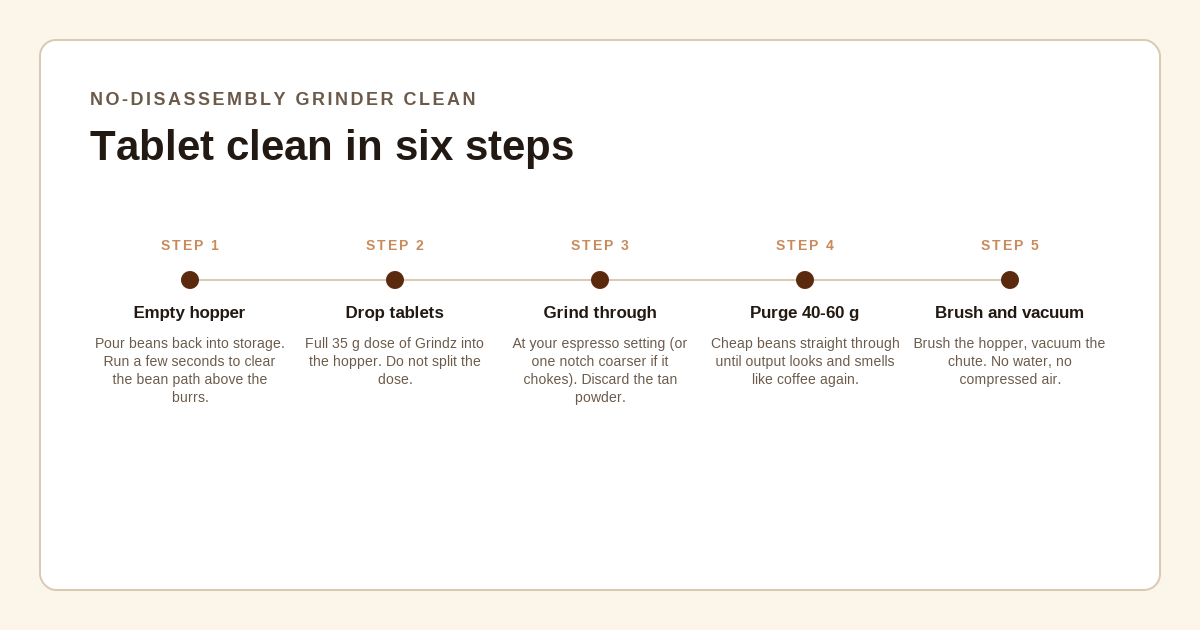
What you'll need
- Grinder cleaning tablets (Urnex Grindz is the common one) : Food-safe, grain-and-starch based. One home-size dose (about 35 g) per clean. Do not substitute rice; see the FAQ.
- A soft brush : A natural-bristle pastry brush or a dedicated grinder brush. For clearing the exit chute and hopper after the tablet run.
- A vacuum with a narrow nozzle : A handheld or a crevice tool on a shop vac. For sucking old grounds out of the chute and burr chamber without opening anything.
- A sacrificial handful of beans : Stale or cheap beans to purge the tablet residue through. Budget 40 to 60 g per clean.
TL;DR
Empty the hopper, drop in one dose of grinder cleaning tablets (about 35 g), grind them through at your espresso setting, then purge 40 to 60 g of cheap beans to clear the residue. Vacuum the chute, brush the hopper, done. Repeat about monthly. This maintains a grinder between the quarterly disassembly cleans; it does not rescue one that has never been cleaned, which needs a proper disassembly first.
For the broader cleaning cadence across the whole setup, see the espresso machine cleaning schedule. This guide is just the grinder.
Why “no disassembly” is a real routine, not a shortcut
Most grinder gunk is two things: coffee oil (sticky, rancid-smelling, dark brown) and coffee fines (dusty, light brown, static-clingy). Both accumulate on the burr faces, in the burr carrier threads, and inside the exit chute. Oils dull flavor by coating fresh grounds with stale fat; fines slow flow and cause dose variation because they build up and then release in clumps.
Grinder cleaning tablets attack both at once. They are harder than coffee residue but softer than steel or ceramic, so they abrade the oils off the burr faces without touching the cutting edges. The crumbled tablet dust also carries fines out of the chute as it exits. A clean through a healthy grinder takes 3 minutes of actual work.
What tablets cannot do: dissolve hardened oil in the corners of the burr chamber (they only touch surfaces the beans would touch), reach above the upper burr carrier, or fix a grinder whose threads are seized with months of fines. If your grinder has never been opened and it’s more than a year old, book an hour for a real disassembly before you bother with tablets. After that reset, this no-disassembly routine carries the grinder between the quarterly disassembly cleans in the cleaning schedule.
The routine, step by step
1. Empty the hopper completely
Pour the beans back into their storage container (or a jar). Run the grinder for a few seconds after it sounds empty to clear the bean path above the burrs. If your grinder has a bean shutoff (Niche, some Eurekas), close it; if not, just accept that the next few grams out will be tablet dust.
2. Drop in a full dose of tablets
Home-size doses are about 35 g; follow the package. Dump the whole dose into the hopper or directly onto the burrs if you have a single-dose grinder like a Niche Zero or DF64. Don’t split the dose; the tablets clean by load, and a half dose cleans less while still leaving residue to purge.
3. Grind at your espresso setting
Turn the grinder on and let it chew through the tablets at your normal espresso grind. The sound will be louder and drier than beans. On a single-dose grinder, you may need to tap the hopper to keep tablets feeding. The output is a pale tan powder that looks like coarse flour; discard it.
Do not grind tablets at a very fine setting on a grinder that chokes easily. If you normally pull 18-in-36-out at a specific setting, that setting is fine. If your espresso setting is silly-fine, bump one or two notches coarser for the tablet run so you don’t stall the motor.
4. Purge beans through until the output looks like coffee again
Put 40 to 60 g of cheap or stale beans in the hopper and grind them straight through. The first 10 to 20 g out will be a muddy mix of coffee and tablet residue (looks grey-brown, smells like crackers). Discard everything until the output is clearly coffee-colored and smells like coffee. Underpurging is the number-one mistake; the next shot you pull will taste like soggy wheat if you cut this short.
5. Brush the hopper, vacuum the chute
Pop the hopper off if it’s removable and brush out any dust in the throat. For the exit chute, hold a vacuum crevice tool at the opening and tap the grinder body; fines will fall out. Do not stick anything metal up into the burrs from the chute side; you can nick the lower burr edge.
6. Pull a throwaway shot
Even after a proper purge, the first shot of actual espresso will taste slightly off. Dose it, pull it, dump it. The second shot is your real dial-in starting point. If that first shot’s grind setting runs noticeably faster or slower than before the clean, that’s normal. See the dialing in guide for the quick re-dial loop; cleaning usually shifts the setting by half a notch at most.
When tablets are not enough
Three symptoms say the grinder needs opening, not another round of tablets:
Rancid smell from the burr chamber. Oil has hardened in corners the tablets cannot reach. You need to remove the upper burr carrier and wipe the chamber walls with a dry microfiber (never water; steel burrs rust fast).
Dial-in that drifts across a single day of use. If the first shot of the morning and the fifth shot pull at noticeably different times on the same beans and setting, fines are accumulating and shedding in clumps. Tablets slow this but don’t stop it once the burr carrier threads are packed.
Visible oil on the lower burr when you shine a light down the chute. You cannot clean a visibly-slick burr with tablets. Open it.
Disassembly on most home grinders is 15 to 30 minutes with a screwdriver and the manufacturer’s YouTube video. Niche, Baratza, Eureka, DF64 all have well-documented procedures. If your grinder is a Mazzer or Mythos pulled from a cafe, budget longer.
Common mistakes
Using rice. The old forum trick. It works, barely, until it stresses a burr edge or costs you a warranty claim. Tablets are cheap; use them.
Skipping the purge. Half a gram of tablet residue in your next double shot tastes like wet cereal and ruins the extraction. 40 g minimum on a normal home grinder, more on a high-retention one.
Running tablets with beans still in the hopper. The beans and tablets grind together, the ratio is wrong for cleaning, and you get coffee-tablet mud in the chute. Empty first, always.
Blowing compressed air into the burrs. It drives fines deeper into the threads and bearings. A vacuum pulls fines out; compressed air pushes them in. Vacuum, don’t blow.
Washing burrs with water. Steel burrs can show rust spots within a day of a wet clean, even if you towel them off. Water near a grinder is for the exterior housing only, and even then, damp cloth not dripping.
Troubleshooting
The grinder stalled on the tablets. The espresso setting was too fine for the tablet load. Back off two notches coarser, restart, then return to your espresso setting for the bean purge. If it stalls repeatedly, the motor is weak or the burrs are already clogged enough that the clean came too late; open the grinder.
The purged coffee tastes like wet cardboard, even after 60 g. Keep purging. Some high-retention grinders (older Mazzers, OEM hoppered machines) hold 10 to 20 g of fines in the chute at all times, and the tablet residue hides in that same pocket. Run another 30 g and taste again. If the taste persists past 100 g, the tablets were old or the grinder has an oil buildup problem that needs disassembly.
My dose weight dropped by a full gram after cleaning. Totally normal. Retention changed because the chute is now clear. Re-weigh for the next few mornings; it stabilizes in 3 to 5 grinds as the chute re-seasons with fresh grounds.
The grinder sounds different after cleaning. Also normal, for about two days. A freshly-cleaned burr set grinds slightly quieter and crisper. If it sounds grindy or metallic (not quieter, but worse), you may have a tablet fragment lodged between the burrs. Run 20 g of beans through on the coarsest setting, then return to espresso fine.
Can I just vacuum the burrs instead of using tablets? A vacuum pulls out loose fines but doesn’t touch oil. Vacuum-only maintenance works for a few weeks on light roasts, but oils build up invisibly and dull flavor before you notice. Tablets about monthly are the baseline; vacuuming in between is a bonus, not a substitute.
Frequently asked
How often should I run grinder cleaning tablets?
About monthly, which for a two-drinks-a-day household is every 2 to 3 lb of beans. That matches the monthly burr-chamber clean in the cleaning schedule; the quarterly full disassembly still stands. If you grind oily dark roasts, run them every 3 weeks. If you only pull light-roast espresso, 6 weeks is fine. More frequent is harmless; the tablets are food-safe.
Can I use rice instead of grinder cleaning tablets?
No. Uncooked rice does scrub out some oil, but it is hard and dense enough to stress burr edges and the motor, and it leaves a starch film behind. Several manufacturers, Baratza among them, tell owners not to use it, and some will not honor a warranty claim after it. Grinder tablets are made to crumble under load and cost a dollar or so per clean.
Do I need to run tablets if I only grind light roasts?
Less often, but yes. Light roasts shed fewer oils but more fine dust, and that dust packs into the burr geometry and the chute just as readily. You will notice it as sluggish flow out of the chute and slowly-drifting dial-in. Every 6 weeks is enough.
Will tablets clean a grinder that has never been cleaned?
Partially. A grinder with a year of oil buildup needs a full disassembly for the first clean; tablets do not dissolve hardened rancid oil in the corners of the burr chamber. Run one tablet dose to knock down the loose material, and if your dial-in is still drifting or the grinder smells rancid, open it up. After that first deep clean, tablets maintain it.
Can I use tablets on a conical burr grinder like a Niche Zero or Baratza Encore ESP?
Yes. Tablets are safe on steel conical burrs and Baratza recommends them for its own grinders. Conical burrs trap grounds around the center cone, which is awkward to brush even with the grinder open, so tablets help them at least as much as flats. On a single-doser whose burrs come out in seconds, a brush does the same job; check the manual.
My grinder has a bean hopper I can't remove. Does that matter?
No. Just make sure the hopper is empty before you drop the tablets in, and purge beans through afterward to clear the chute. If beans and tablets are mixed in the hopper, you will grind a weird blend into your next shot and it will taste awful.