
Why is my espresso watery?
Watery espresso is almost always under-extraction: grind too coarse, dose too low, or yield too high. Here's how to diagnose and fix it.
What you'll need
- A 0.1 g scale : Mandatory. Without measuring dose and yield, you can't tell if a watery shot is recipe or technique.
- A bottomless (naked) portafilter : The fastest channeling detector you can buy. If your machine takes a 58mm, one exists for it.
- Fresh beans : Roasted within the last 4 to 6 weeks. Stale beans pull thin and watery no matter what you do to the grind.
- A real (non-pressurized) basket : If your portafilter has a plastic insert or a single small hole on the bottom, that's the problem. Replace it.
TL;DR
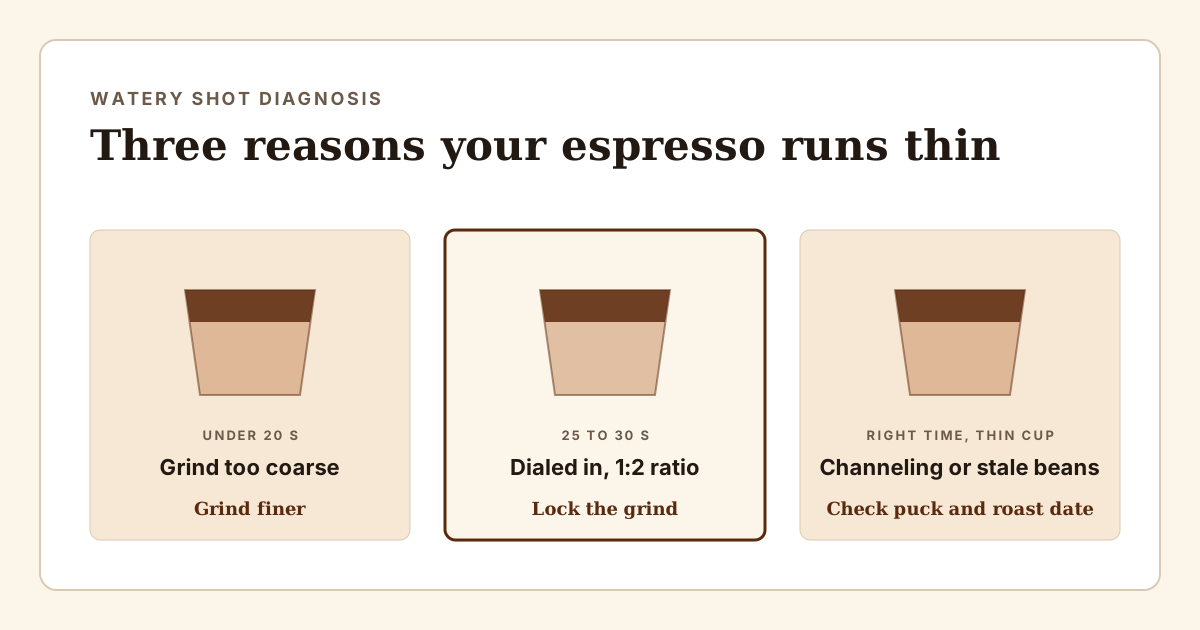
Watery espresso means under-extraction: water passed through the puck too fast and pulled out volume without flavor. Three causes, in order of likelihood: grind too coarse, dose too low, or yield too high. Fix the grind first (go finer until the shot takes 25 to 30 seconds), confirm your dose is at basket spec, and stop the pour at a 1:2 ratio. If grind adjustment does nothing, you’re either channeling or running a pressurized basket, both of which fake the symptoms of a normal shot.
What “watery” actually means
A watery espresso is one where the cup is thin, pale, sour or hollow-tasting, and runs more like strong tea than syrup. Mechanically, the water moved through the coffee puck faster than it should have, so it picked up the easily-soluble sour and salty compounds but never had time to extract the sweet and bitter ones that give espresso body.
Three numbers describe every shot: dose in, yield out, time. A watery shot fails on time. Either:
- It hit the right yield (say 36 g) in 12 seconds instead of 28. Fast and weak.
- It hit a much higher yield (60 g) in a normal-looking time because you didn’t stop the pour. Long and weak.
- It hit the right yield in the right time, but the puck channeled and most of the water bypassed the coffee entirely. Looks normal, tastes empty.
Crema can lie about all three. A fresh bean produces thick crema even on a terrible shot, and a pressurized basket produces fake crema regardless of what’s happening inside. Trust the scale, the timer, and the taste, not the foam.
The fix, in order
Run these checks in sequence. Don’t skip ahead; later steps assume the earlier ones are clean.
1. Are you using a real (non-pressurized) basket?
Look at the bottom of the basket inside your portafilter. A real basket has hundreds of tiny laser-drilled holes covering the entire bottom. A pressurized basket has a plastic insert or a single small hole, sometimes hidden under a metal cap. Pressurized baskets are designed for pre-ground supermarket coffee and they fake back-pressure regardless of grind size. With one of these, no amount of dialing in will make the shot taste like espresso. The cup is thin foam and water by design.
Fix: replace the basket with the standard double basket your machine accepts (58mm for most prosumer; 54mm for Breville/Sage; 51mm for Gaggia and some DeLonghi). $15 part. This is the most common reason a new-machine owner reports watery shots.
2. Weigh the dose
Pull out the basket and weigh what’s in it. For a standard 18 g double, you want 18.0 g plus or minus 0.2. If you’re under-dosing at 14 or 15 g (common with people scooping by eye), the puck is thin and water blasts through it. The shot finishes in 10 to 15 seconds and tastes weak no matter how fine you grind.
Fix: grind directly into the portafilter, weigh, adjust. Don’t try to dial in by sight.
3. Time and weigh the shot
Put a scale under the cup. Start the brew and the timer at the same moment. Stop the brew yourself when the scale reads 2x your dose (36 g out from 18 g in). Note the time.
- Under 20 seconds: grind finer. This is the most common watery-shot cause. Move one or two notches on a stepped grinder, a small turn on a stepless one. Re-pull. (See how to dial in espresso for the bracket-and-narrow process.)
- 20 to 25 seconds: grind a hair finer. Borderline.
- 25 to 30 seconds: good time. If it still tastes watery, jump to step 4 (channeling) or step 5 (beans).
- Over 33 seconds: not your problem. A slow shot tastes bitter, not watery.
If your machine has a volumetric “espresso” button that pre-programs the pour, turn that off or learn to manually stop it. Volumetric buttons keep running until they hit a preset volume, which is often closer to 60 g than 36 g. An unintentional 1:3 or 1:4 pour is watery by definition; a deliberate lungo is a different recipe with a coarser grind (see espresso ratios explained).
4. Check for channeling
If the shot pulls in the right time at the right yield and still tastes watery, water is finding a low-resistance path through the puck instead of saturating it evenly. This is channeling, and it’s invisible from above the portafilter.
A bottomless portafilter shows it immediately: watch the underside of the basket during the pull. The visual tells and the fix order (distribution first, then a level tamp) are covered in the linked guide.
5. Check the beans
Stale beans pull watery and never dial in. Past about 6 weeks from roast, beans lose the CO2 that creates back-pressure during extraction. Water rushes through, no matter the grind. Past 3 months, you can grind to flour and still get a thin shot. The bag’s “best by” date is usually 12 months and meaningless; look for a roast date stamped on the bag.
Fix: buy from a roaster that prints roast dates. Use beans between 1 and 4 weeks post-roast for best results. If your supermarket beans don’t have a roast date, assume they’re 6+ months old and replace them before troubleshooting anything else.
Common mistakes
Adjusting grind by tiny amounts. Beginners often move the grinder one tick, see no change, and conclude the grinder doesn’t matter. Grinders hold the previous grind in the chute, so purge roughly a gram after any setting change before the new size shows up, and the first adjustment from “way too coarse” might need 5 to 10 notches finer. Be bolder until you see the shot time move, then narrow in.
Chasing watery with a higher dose. Cramming 20 g into an 18 g basket increases puck density, which slows the shot, which can make a too-coarse grind look like it’s working. That hides the symptom instead of correcting the grind. You end up with bitter, dense shots from a basket that’s mechanically overstuffed. Dose to basket spec; fix the grind.
Blaming the machine. Sub-$300 pump machines with pressurized baskets produce watery espresso by design, but every other pump machine sold (Bambino, Gaggia Classic, Silvia, anything prosumer) can pull a syrupy shot if the grind, dose, and beans are right. The machine is almost never the problem.
Tasting the shot too hot. Espresso at 80°C reads as bitter and thin; the same shot at body temperature reads as sweet and full. Wait 60 seconds before judging.
Pulling through a clogged shower screen. If you haven’t backflushed in months, oil buildup on the screen disperses water unevenly across the puck. The result mimics channeling. Backflush with detergent monthly and this disappears.
Troubleshooting
For taste-based diagnoses across other espresso faults, start from the troubleshooting decision tree. The specifics below are the watery-shot cases.
The shot is fast and watery on the finest grind setting my grinder has. Either the grinder is below espresso-capable (most blade grinders, the Baratza Encore without the ESP burr, most $50 hand grinders) or the burrs are dull. Espresso needs a grinder that can produce a setting where 18 g resists water for 25+ seconds. If you’ve genuinely run out of fine, the grinder itself is the limit and no other change will help.
The shot starts thick and dark, then goes pale and runs fast. Normal. Espresso always thins out toward the end of the pull as solubles deplete. This is “blonding” and the reason you cut the shot at 36 g. If it’s blonding by 15 g, the shot is way too fast (grind finer). If it never blonds by 50 g, you’re choking the puck (grind coarser).
I dialed in yesterday and today’s shots are watery again. Beans degas and shift for the first two weeks after roast, so a setting that worked on day 3 can be a notch too coarse on day 5. Re-dial slightly every few days for the first two weeks of a new bag. If it’s a brand new bag from the same roaster as last week, you may have hopped roast batches; treat it as a new bean.
The shot pulls in 28 seconds, yields 36 g, looks great, and still tastes thin. Two likely causes. Either the puck channeled invisibly (use a bottomless portafilter to confirm), or the beans are past their prime. A third less common cause: brew temperature is too low. If your machine has temperature adjustment (PID, dual boiler), try raising it by 2°C. If it doesn’t, give the machine an extra 15 minutes to heat-soak before the first shot.
My espresso is watery only on the first shot of the day. Classic cold-machine symptom. Group heads need 20 to 30 minutes from power-on to reach stable brew temperature, even when the boiler light says ready. Either wait longer or run a blank flush of hot water through the group right before pulling.
Frequently asked
My shot looks watery but the scale says 36 g out of 18 g in. Is it really watery?
Probably yes, in flavor. A correct yield doesn't guarantee a correct extraction. If water raced through the puck in 12 seconds and hit 36 g, you got volume without solubles. The cup will taste thin, sour, and weak even at a textbook ratio. Shot time matters as much as yield.
Why does my espresso have lots of crema but still taste watery?
Crema isn't strength. Fresh beans and pressurized baskets both produce thick crema independent of actual extraction. A pressurized basket especially produces fake crema from agitation, not from a properly extracted puck. Taste, not appearance, tells you whether the shot is watery.
I'm using a Nespresso/pod machine and the espresso is watery. What can I do?
Not much. Pod machines pre-meter water volume and you can't change dose, grind, or yield. If the shot is consistently watery, the pod brand or model is the limit. Some machines (Vertuo, original line) have a manual stop button; press it sooner for a more concentrated shot. Beyond that, you've hit the ceiling of the product.
Does the machine's pressure matter? Mine doesn't have a gauge.
For watery shots, almost never. 9 bar is the standard and every pump machine sold for espresso hits it. Low pressure produces a slow, weak shot, not a fast watery one. If your shot gushes in 10 seconds, that's a puck-resistance problem (grind, dose, channeling), not a pump problem.
Can hard water cause watery espresso?
Indirectly. Heavily scaled boilers and group heads lose temperature stability, which can under-extract. But you'd notice scale long before this (slow heat-up, mineral flecks, descaler running brown). Hard water itself doesn't make a fresh shot watery; it damages the machine over months.