
How to descale your espresso machine
Run a descale cycle that actually removes mineral buildup, then flush thoroughly so the next shot doesn't taste like solvent.
What you'll need
- A commercial descaler : Citric-acid or sulfamic-acid based. Urnex Dezcal is the common pick. Don't use vinegar (see the FAQ).
- A jug of distilled water : For the rinse cycles. Tap water during the rinse defeats the point of descaling.
- A 1-liter container under the group head : Anything that holds the run-off so you don't flood the drip tray. A pyrex measuring cup works.
- An empty water tank : Pull it out, dump remaining water, give it a quick rinse before adding the descaler solution.
TL;DR
Empty the water tank. Fill it with descaler solution at the manufacturer’s dilution. Run the descaler through both the brew group and the steam wand in alternating bursts so the solution contacts every surface that touches water. Let it sit 15–30 minutes. Run two full tanks of fresh water through afterward; one minimum to flush, a second to be sure. Pull a sacrificial shot before resuming normal use.
How often, and why
Descaling (also called decalcifying) removes the limescale (calcium carbonate) that builds up wherever heated water sits: boilers, pump valves, group head outlets. Every espresso machine has it; the only question is whether you remove it on a schedule or wait for symptoms. It’s the quarterly job in the broader espresso machine cleaning schedule.
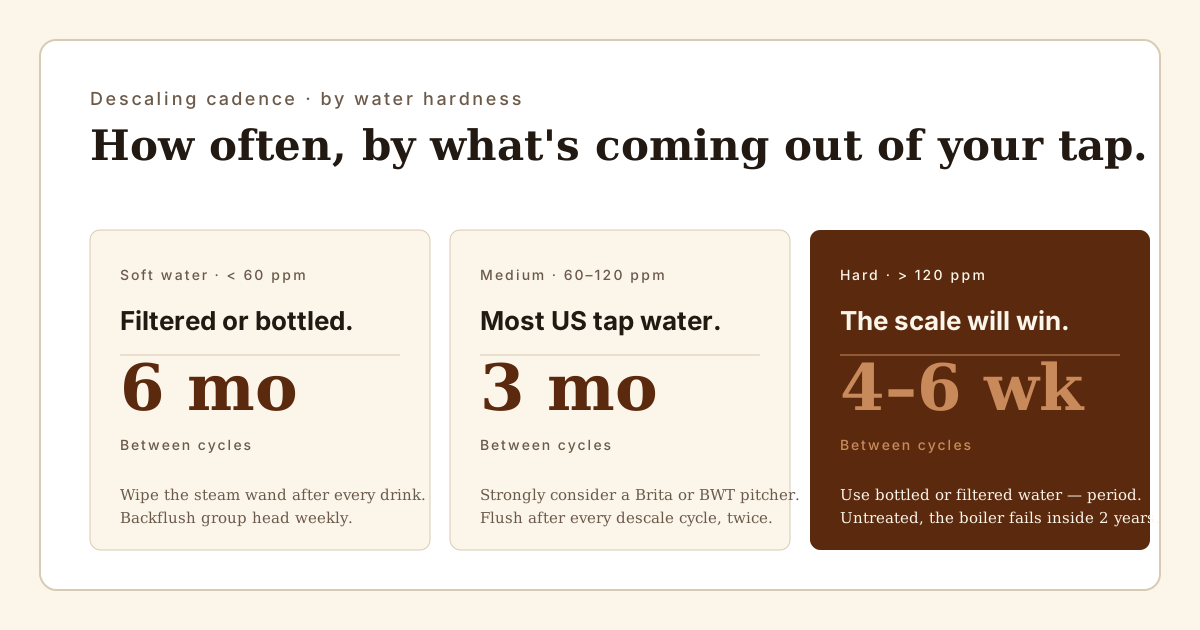
- Hard water (over 7 grains per gallon / 120 ppm CaCO₃): every 4–6 weeks.
- Medium water (3–7 gpg): every 2–3 months.
- Soft water or always filtered: every 3–6 months.
Skipping descaling doesn’t make scale go away. It just delays the work and concentrates it. By the time a heavily-scaled machine throws its first error, the descale process can require multiple cycles to recover.
If your shots have started tasting off gradually rather than overnight, descaling is one possibility on a list. Work through the troubleshooting decision tree to confirm scale is the cause before running a cycle on a clean machine.
Descaling with citric acid
Citric acid is the cheapest effective descaler, and it’s what most commercial powders are based on anyway. Food-grade citric acid powder (the kind sold for canning and cleaning) works on most pump machines: dissolve about 30 g per liter of warm water, roughly two tablespoons. It dissolves calcium carbonate without the metal-attacking downside of vinegar, and it rinses out far faster.
Two cautions. Stronger is not better; over-concentrated acid attacks seals, so stick to the ratio. And don’t use citric acid (or any DIY descale) on an E61 group head or certain heat-exchanger machines, where residue can bind in the brass internals; those need a manufacturer-specified product or a shop service. Otherwise, citric acid and a commercial citric-based descaler are interchangeable, so use whichever you have on hand.
Which descaler should you buy?
“Best descaling solution” comes down to four practical options, and for most pump machines they’re closer than the marketing suggests. They’re all some blend of citric or sulfamic acid:
- Food-grade citric acid powder. Cheapest by far, pennies per cycle, and the same active ingredient as most branded powders. Best if you descale often and don’t mind measuring (30 g/L, see above).
- Urnex Dezcal. Citric/sulfamic blend in pre-measured sachets. The foolproof default: no measuring, widely stocked, machine-agnostic. You’re paying a premium for the convenience.
- Durgol Swiss Espresso. Liquid, fast-acting, no mixing. Popular with De’Longhi and Jura owners. More per use, but it pours ready and rinses cleanly.
- Machine-branded descaler (Breville, De’Longhi, Gaggia). Chemically the same family. Worth buying only if your warranty explicitly requires the branded product, which a few do. Otherwise it’s a markup on the same acid.
What to avoid: vinegar (harsh on brass and aluminum, the smell lingers, see the FAQ) and “natural” lemon-juice hacks (too weak, and the sugars gum up valves). For an E61 group head or many heat exchangers, skip DIY entirely and use the manufacturer-specified product or a shop service.
Step by step
1. Empty and rinse the tank
Pull out the water tank, dump whatever’s left, give it a quick rinse with tap water. Wipe out anything visible at the bottom.
2. Mix the descaler
Follow the descaler’s label. A typical ratio is one packet per liter, or about 2 tablespoons of citric acid per liter. Don’t free-pour. Too concentrated and it’ll over-attack seals; too weak and it won’t dissolve much scale.
3. Pour into the tank, slot it back in
Make sure the machine is on and at brew temperature. Place the 1-liter container under the group head.
4. Run the brew group
Pull the lever or press the brew button as if pulling a shot, but with no portafilter (or with a portafilter and a blanking disc). Run for ~15 seconds, stop, wait 30 seconds (gives the descaler dwell time on hot internals), then run another 15 seconds. Repeat 3–4 cycles.
5. Run the steam wand and hot water tap
Open the steam wand into the container for 5–10 seconds. Then run the hot water tap (if you have one) for the same. This pulls descaler through the steam circuit, which doesn’t see the brew water on most machines.
6. Let it sit
Turn the machine off and let the descaler dwell in the system for 15–30 minutes. This is when most of the actual chemistry happens.
7. Empty and rinse with distilled water
Pull the tank, pour out the remaining solution, rinse the tank thoroughly. Refill with distilled water for the flush. Tap water during the flush re-introduces minerals exactly where you just removed them.
8. Flush, twice
Run the brew group and the steam wand exactly like you did with the descaler, multiple short bursts, until you’ve used a full tank of distilled water. Refill and do it again with a second full tank. The second tank is non-negotiable; trace descaler in the boiler will taste in shots for days.
9. Refill with normal water and pull a sacrificial shot
Throw away the first shot. The second shot should taste normal. If it doesn’t, run another half-tank of fresh water through.
Common mistakes
Skipping the dwell time. Pumping descaler through and immediately flushing wastes most of the chemical. The 15–30 minutes of contact time is when scale actually dissolves. Don’t shortcut it.
Only flushing once. Descaler residue tastes like metallic acid: sharp, mineral, vaguely chemical, completely unmistakable in the cup. The shot that teaches everyone to flush twice is usually the first post-descale shot pulled after a single flush, and it tastes like a swimming pool. One flush isn’t enough; the second tank is what makes the machine usable again. If shots taste off for the next few days, you under-flushed.
Using vinegar. Already covered in the FAQ. The smell stays in the boiler for weeks and the acetic acid is harsh on brass and aluminum. Use commercial descaler.
Forgetting the steam circuit. Most machines route brew water and steam water through different paths. If you only run the brew group, the steam wand and hot water tap stay scaled. Run both.
Descaling a clogged group head and expecting it to fix flow problems. If your shots are choking before descaling, the issue is usually grind or a dirty basket and shower screen, not scale. Clean the portafilter and group head first; descale on a schedule, not as a panic response to a slow shot.
Troubleshooting
The first post-descale shot tastes like chemicals. Under-flushed. Run another tank of fresh water through both circuits, then pull a couple of throwaway shots before drinking.
Steam pressure didn’t recover. The steam side wasn’t fully flushed, or there’s scale in the steam wand tip itself. Unscrew the tip (most are removable), soak it in fresh descaler solution for an hour, rinse, reinstall.
The machine threw an error mid-descale. Usually a temperature sensor reading the descaler differently than water. Power off, wait 10 minutes, power back on. If it persists, check the machine’s manual for descale-mode error codes.
Scale visibly came out of the steam wand and stained the drip tray. That’s the goal. That’s calcium carbonate and you just removed it. Wipe the tray, refill with distilled water, finish the flush.
Frequently asked
Vinegar vs. commercial descaler, does it matter?
Yes. Vinegar dissolves scale but its acetic acid is harsh on aluminum and brass internals, and the smell lingers in the boiler for many cycles. Citric or sulfamic acid (in Urnex, Cafiza, Durgol, etc.) targets calcium carbonate without attacking metal. Use commercial descaler.
How do I know if I need to descale?
Three signs to watch for. Your shots take noticeably longer than they used to, the steam pressure has dropped, or you can hear an unusual hissing/gurgling from the boiler. With hard water you should descale every 4–6 weeks regardless. With soft or filtered water, every 2–3 months is enough.
Will descaling damage the pump or seals?
Properly diluted descaler is safer for your machine than the scale buildup is. Skipping descaling is what kills pumps; scale clogs the solenoid valves and overworks the pump. Follow the manufacturer's dilution and you won't have problems.
My machine has a built-in descale mode. Should I use it?
Yes, if it has one. Built-in modes are calibrated for the boiler size and pump rate. Use the descaler the manufacturer recommends or any equivalent commercial one, but follow the on-screen prompts.
Can I descale a heat-exchanger or dual-boiler the same way?
Same principle, different procedure. Heat exchangers and dual-boilers have separate brew and steam circuits that both need flushing, and the order matters. Some HX machines (notably E61 group heads) shouldn't be descaled with citric acid by the user at all because the residue can bind in the group head's brass internals. Read your manual first; if it doesn't explicitly cover descaling, that's the manufacturer telling you to bring it in.